
When I took a friend who grew up in India to lunch, he asked me if I would like to go to a Chinese restaurant. I told him that I prefer to go to other styles. I also told him that I don’t cook much Chinese food at home. Scotch egg is another example of my exploration for dishes/recipes with a different cultural background. Like most of recipes I cook, the ingredients and cooking technique are simple. It takes a little effort but it’s a fun dish to cook.
When I tried to understand the history of this recipe, I found out its origin is not as clear as the word, “Scotch” indicates. Here is what I found on theguardian.com about its origin (https://www.theguardian.com/notesandqueries/query/0,,-1188,00.html).
Version 1:
The practice of encasing a pre-cooked egg in forcemeat developed not in Scotland, but in North Africa. The technique made its way to Britain via France and was first recorded in England during the reign of Elizabeth I. Scotch eggs were originally spiked with cloves and highly spiced in an attempt to sweeten the often putrefying meat. The term itself is obscure but may come, though I doubt it, from a corruption of the word ‘scorch’ (which in Elizabethan times had ribald associations). The first Scotch eggs were cooked over a naked flame, after all. For more about Scotch eggs and Algerian cookery see Colin Cutler’s excellent book, 1001 Strange Things (Beaver Books, 1970).
Version 2:
Scotch eggs originated in the Whitby area of Yorkshire in the late 19th century. Originally, they were not covered in sausage meat but in a rich, creamy fish paste before being sprinkled with breadcrumbs. Their name in those days was ‘Scotties,’ allegedly because they were made at an eatery by the name of William J Scott & Sons close to the seafront. Hence, over a period, the term Scotch eggs was adopted. This was thought to be because the major food stores who started selling the delicacy were unhappy with the name and adopted a more formal approach to marketing. Sausage meat replaced the fish paste purely for packaging reasons. Although on my last visit to Scarborough, the original recipe was still being used in a local cafeteria. More information can be obtained from Culinary Delights of Yorkshire by Peter Bone (R Fyfe & Co, 1981)
Version3:
According to A Caledonian Feast by Annette Hope (Grafton Books, 1989), Scotch eggs were an Indian export in the early 19th century, along with curry and kedgeree. The dish was first mentioned by Meg Dods, circa 1830, in one of her recipe collections. Annette Hope continues: ‘It bears an odd similarity _ striking though probably coincidental _ with an Indian dish called nargis kofta, which consists of hard-boiled eggs coated with cooked spiced minced mutton and fried, then cut in half and served in a sauce of curried tomato and onion’ (Page 251)
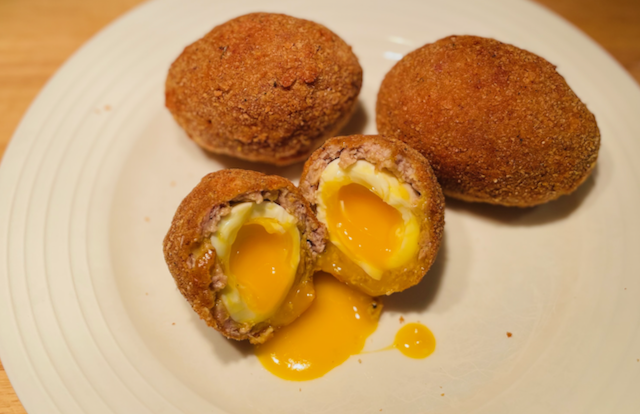
Scotch Egg 苏格兰炸蛋

Equipment
- 7-8" sauce pan
- 3 large bowl
Ingredients
- 11 oz ground pork (sausage pork)
- 4 eggs
- 1 tsp salt
- 1 tsp ground black pepper
- 1 tsp garlic powder
- 4 cups neutral flavor oil
Instructions
- Add water to the sauce pan, and heat to boil
- Add three eggs to the boiling water, keep heat at medium, and boil for 5-6 mins
- Immediately chill the eggs with ice water. After 4-5 mins, gently crack the eggs, and soak them in the water for another 4-5 mins. Carefully peel the eggs.
- Rinse the sauce pan, and dry it on the stove top
- Add the ground pork, salt, garlic powder, and ground pepper to the large bowl
- Mix the pork and seasonings. Divide the mixed pork to portions with each weighing about 4oz (90gram)
- Take one portion of the pork, press gently with your hands to make it flat, place an egg into the flattened pork, and place it on the palm of one hand
- With the help of the other hand, carefully push the pork to wrap around the egg
- Prepare the bowl of flour, egg wash, and bread crumbs
- Dip the egg/meat ball in flour, egg wash, and bread crumbs. Use both hands to gently press the loose bread crumbs firmly stick to the meat ball surface
- Add oil to the sauce pan, and heat it at high heat until the oil is hot
- Add the coated meat balls to the hot oil, and fry for about 5 mins
- Take out the fried egg/meat balls, and place them on paper towel to absorb excess oil
- Ready to serve
Video
Notes
- -If you want to have fully cooked yolk, boil the egg for 7-8 minutes
- -Use premixed sausage meat from grocer would save your time for preparing the meat
Recent Comments