
When I was young, most families I knew ate noodles they made at home. I used to help my parents roll out dough sheets and cut it to noodles. I wasn’t experienced enough to have an optimal flour-to-water ratio. I also wasn’t strong enough to knead the dough. That was almost 40 years ago. Back then, people didn’t want to spend limited cash on premade foods from stores. The food variety and supply were scarce in those days. Noodles were made just with flour and water. Once it’s cooked, you needed to eat it as soon as possible. Otherwise, noodles would be soaked with soup and lose its texture and shape.
Throughout my life, I never independently made noodles by myself. I never thought I would like to make noodles/pasta at home as I could conveniently buy “fresh” pasta from stores. Recently, I came to realize that noodles/pastas, dry or fresh, have a high sodium content. I do know, when cooking pastas, all online recipes suggest making the water taste like ocean water. People also add cheese or other sauces or toppings to their cooked pasta. I can’t image what the sodium content would be for a “tasty” pasta dish. For that reason, I decided to make noodles/pasta at home. That way, I could eliminate the salt.
As usual, I like to keep my ingredients, preparation, and cookware as simple as possible. Some recipes call for either “OO” or semolina flour, but I just use all-purpose flour. Rolling the dough with a machine would be easier and more uniform, but I don’t want to buy a machine yet. I took the physical effort to mix and roll out the dough with my hand and a rolling pin. When I cooked the noodles, I just boiled them with plain water for 3-4 mins. After draining the water, I top the noodles with premade meat sauce or serve with seafood or pork chops. Like other dishes I cook, I don’t strictly follow common-sense rules.
This is the first time I ever make noodles all by myself from beginning to finish. Since this is my first try, my dough was on the dry side. I didn’t have to use flour when I was rolling the dough. The sheet didn’t stick to the surface. The negative side is I had to use more effort to knead and roll. I have to say my noodles are not as beautiful as some of those fancy recipes. However, if I could make it, you could make it too.
Note: I heard an optimal flour/egg (liquid) ratio is 300g: 185g. I haven’t tried it yet. Plus, you would need a scale.
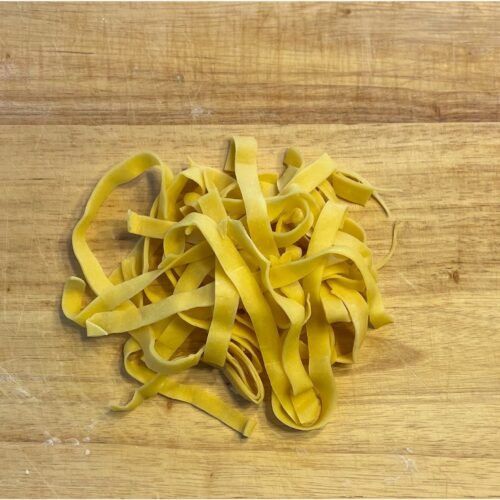
Simple Egg Noodle/Pasta 鸡蛋面

Equipment
- small mixing bowl
- large mixing bowl
- Rolling Pin
- cutting board
Ingredients
- 2 cups all-purpose flour
- 8 pieces egg
Instructions
- Crack the eggs. Only take 2 whole eggs (white and yolk) and 6 yolks. Whip the eggs/yolk in the small mixing bowl
- Put two cups of all-purpose flour into the large mixing bowl. Make a well in the center
- Add the whipped egg/yolk to the flour well. Use a spoon/fork to slowly incorporate the egg into the flour
- Once all the egg liquid is absorbed by the flour, use one hand to press and mix to incorporate all flour/egg flakes to the dough to form a ball
- Dust some flour on the cutting board (or a flat surface). Knead the dough for 7-10 mins (use one palm to press and roll the dough). If the dough is too hard to knead, wet your hand with some water, or if the dough is too wet (sticky), dust more flour on the surface.
- Once the dough surface become smooth, cover it with a damp towel (paper towel) and wrap it with plastic wrap. Let it rest.
- After at least 30 mins (60 mins preferred), take the dough out and knead for 3-4 mins.
- Cut the dough to 4-8 pieces. Use a rolling pin to roll each piece of dough to a 1mm thick pasta sheet (could almost see light through). If the dough is sticky, dust some flour.
- Fold or roll the pasta sheet. Cut it to the width you prefer
Recent Comments